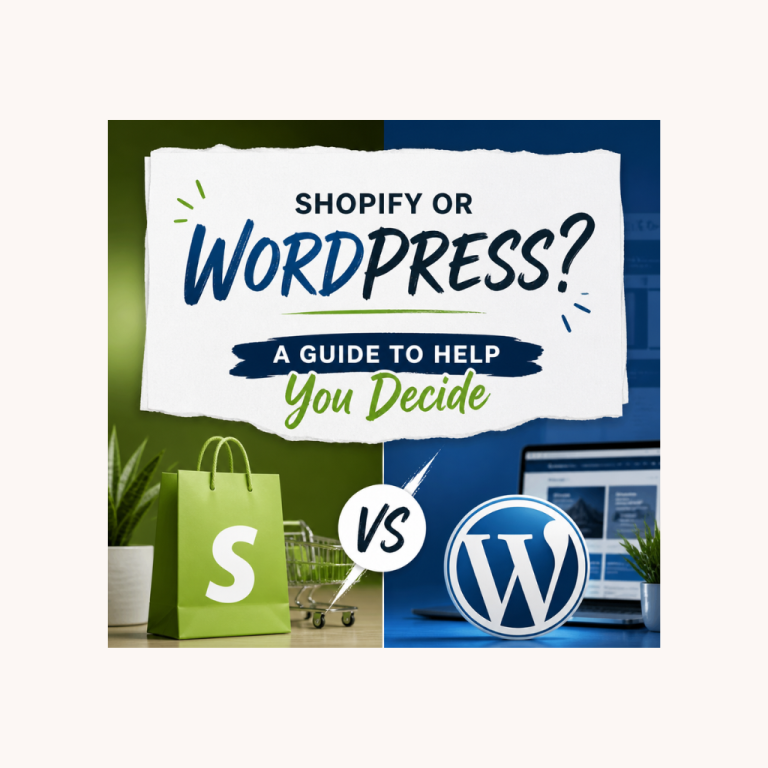

Shopify vs WooCommerce – which should you choose?
Two platforms. Both excellent. Both wildly popular. And a genuine decision that affects everything from your monthly costs to your SEO capability to whether you own your shop or someone else does.
Shopify vs WooCommerce is one of the most-searched comparisons in e-commerce, and most articles about it either oversimplify the answer or have a financial incentive to push you towards one platform regardless of your situation.
This one doesn’t. Both platforms have affiliate programmes, and both are linked from this site. The recommendation at the end is based on what’s genuinely right for different situations, not which pays more – and US and UK pricing is shown side by side throughout.

The one-paragraph version
Shopify is a purpose-built, all-in-one ecommerce platform. You pay a monthly subscription, everything is managed for you, and you can have a professional shop live in an afternoon with no technical knowledge.
WooCommerce is a free plugin for WordPress that turns your WordPress site into a fully functional online shop. The software is free; you pay for hosting separately; you own everything completely; and the combination of WordPress’s content capabilities with WooCommerce’s ecommerce functionality is more powerful than Shopify for certain use cases.
Neither is universally better. The right choice depends on what you’re selling, how you plan to drive traffic, your budget, and how technically confident you are.

What each platform fundamentally is
Understanding the architecture of each platform helps explain why they make the choices they do.
Shopify
Shopify is a Software as a Service (SaaS) ecommerce platform. You subscribe to it monthly, everything runs on Shopify’s infrastructure, and Shopify handles hosting, security, updates, and maintenance. You log in, manage your shop, and Shopify handles everything behind the scenes.
It was built from the ground up specifically for selling online. Every feature – checkout, inventory, shipping, payments, discount codes – was designed with e-commerce in mind from the start.
WooCommerce
WooCommerce is an open-source plugin for WordPress – the world’s most popular website platform. It’s free to download and install, and it extends WordPress’s publishing capability with a complete e-commerce layer.
Because it’s built on WordPress, WooCommerce inherits everything WordPress is good at – world-class content publishing, the best SEO tools available, complete ownership and control, and an ecosystem of over 60,000 plugins. It also inherits the responsibility that comes with self-hosted software – you manage your own hosting, updates, and maintenance.

Ease of setup and use
Shopify
Shopify wins on ease of setup, and it’s not particularly close.
From signup to a live shop with products, payments, and shipping configured, it’s realistic to do in an afternoon for most people. The onboarding is purpose-built for getting a shop live. The dashboard is clean, the steps are logical, and the path is well-marked throughout.
Adding products is straightforward: title, description, images, price, variants, and inventory. Payment processing is set up in minutes via Shopify Payments. Shipping zones and rates have sensible defaults. You don’t need any technical knowledge to get started.
Ongoing management is also simpler on Shopify. Updates happen automatically. Security is handled. You focus on the shop rather than the infrastructure.
WooCommerce
WooCommerce has a steeper initial learning curve. You need hosting, a WordPress installation, WooCommerce, a compatible theme, and likely several additional plugins before you have a functional shop. Each of these is manageable individually, but the combined effort exceeds what Shopify demands.
The WooCommerce setup wizard has improved significantly and handles basic configuration well. With a good hosting provider, SiteGround’s one-click WordPress and WooCommerce installation, for example, the technical barrier is lower than it used to be.
Once set up, day-to-day management of a WooCommerce store isn’t significantly more complex than Shopify. The learning curve is front-loaded. The ongoing experience is comparable.
Winner for ease of use: Shopify – meaningfully lower friction for setup and ongoing management, particularly for complete beginners.

Pricing – the full picture
This is one of the most important comparisons to get right because the headline numbers are misleading in both directions.
Shopify pricing
Basic plan: USA ~$25/month (paid annually) or ~$32/month (monthly), UK ~£19/month (paid annually) or ~£25/month (monthly)
Shopify plan: USA ~$64/month, UK ~£49/month (paid annually)
Advanced plan: USA ~$336/month, UK ~£259/month (paid annually)
Transaction fees – if you use Shopify Payments (available in both the US and UK), no additional fees beyond standard card processing rates. If you use a third-party payment processor, Shopify charges an additional 0.5–2% per transaction.
Apps – most Shopify stores add paid apps. A realistic basic Shopify store with a few useful apps (reviews, email marketing, advanced shipping) typically costs $39–$78/month (USA) or £30–£60/month (UK) total.
Domain name – not included, ~$12–$15/year (USA) or ~£10–£15/year (UK) separately.
WooCommerce pricing
WooCommerce plugin – free.
Hosting – from ~$4.99–$28/month (USA) or ~£3.50–£21/month (UK) depending on your traffic and requirements. SiteGround GrowBig is a sensible starting point for most WooCommerce stores.
Domain name – ~$12–$15/year (USA) or ~£10–£15/year (UK).
Theme – free themes (Kadence, Astra, Storefront) are excellent. Paid themes $50–$100 (USA) or £40–£80 (UK) one-off if needed.
Premium extensions – WooCommerce Subscriptions (~$190/£149 a year), WooCommerce Bookings (~$228/£179 a year), and advanced shipping extensions (~$101/£79 a year) if you need them. You don’t need all of these – or any of them for a basic shop.
Transaction fees none from WooCommerce. You pay your payment processor’s rates only.
Realistic annual cost comparison
| Setup | Shopify (USA) | Shopify (UK) | WooCommerce (USA) | WooCommerce (UK) |
|---|---|---|---|---|
| Basic shop, year one | ~$356 | ~£270 | ~$70 | ~£55 |
| Basic shop, year two | ~$356 | ~£270 | ~$166 | ~£130 |
| Shop with key extensions | ~$634+ | ~£480+ | ~$385–$642 | ~£300–£500 |
For a lean basic shop, WooCommerce is significantly cheaper, in both markets. For a feature-rich shop with multiple paid extensions, the cost gap narrows considerably. At scale, the lack of transaction fees on WooCommerce becomes increasingly valuable.
Winner on price: WooCommerce – meaningfully cheaper for most configurations, particularly for high-volume sellers where the absence of transaction fees matters.

E-commerce features
Shopify
Shopify’s ecommerce features are purpose-built and polished. Everything you need to run a shop is either built in or available through its 8,000+ app ecosystem.
Checkout – one of Shopify’s strongest cards. The checkout is fast, mobile-optimised, and trusted. Shop Pay accelerated checkout reduces friction for returning customers across all Shopify stores. Conversion rates on Shopify checkouts are consistently strong.
Inventory management – clean and capable. Multiple variants, locations, bulk editing, CSV import/export, and low-stock alerts all work well.
Shipping – built-in rates, zones, weight-based pricing, carrier-calculated rates, and label printing. Discount rates with major carriers on higher plans.
Multichannel selling – sell on your website, Instagram, Facebook, TikTok, and in person from a single dashboard. One of Shopify’s clearest differentiators for modern sellers.
Abandoned cart recovery – built in on all plans. Automatically emails customers who don’t complete their purchase.
WooCommerce
WooCommerce covers all standard e-commerce needs out of the box and can be extended to handle almost anything through its extension ecosystem.
Checkout – functional and customisable. The default checkout is solid but not as polished as Shopify’s. Optimising it for conversion requires additional configuration or extensions, such as CartFlows. Guest checkout, one-page checkout, and field customisation are all available.
Inventory management – covers standard needs well. Complex multi-location inventory or very large catalogues benefit from dedicated inventory management plugins.
Shipping – built-in flat rates, free shipping, and local pickup. More complex shipping rules require the Table Rate Shipping extension (~$101/£79 a year). WooCommerce Shipping integrates with major carriers for label printing.
Product types – simple, variable, digital, virtual, grouped, and external products are all supported natively. Subscriptions and bookings require paid extensions.
No transaction fees – beyond your payment processor’s own rates, WooCommerce charges nothing per transaction. At meaningful sales volumes, this is a significant advantage.
Winner on ecommerce features: Shopify for out-of-the-box, polished ecommerce. WooCommerce for flexibility, cost, and ownership.

Content and blogging
This is where the comparison shifts decisively, and it’s one of the most important factors for a significant proportion of online sellers.
Shopify
Shopify has a blog function. It works. You can write and publish posts, organise them in categories, and add content to support your products.
The writing experience is basic compared to WordPress. SEO options at the content level are restricted. Managing a large content archive is cumbersome. And Shopify’s URL structure for blog posts is less flexible than WordPress’s.
For any seller whose traffic strategy depends on content marketing, blogging, SEO, and building an audience around a topic, Shopify’s content tools will frustrate you over time.
WooCommerce
WooCommerce on WordPress gives you the world’s best content publishing platform alongside your shop, simultaneously, on the same installation.
The Gutenberg block editor. Full category and tag taxonomy. Scheduling. Full SEO control with Rank Math. Editorial workflow tools that scale to any content volume. The ability to rank for hundreds of informational keywords alongside your product pages.
For a seller where content is central to discovery a food brand that publishes recipes, a fitness business that publishes training guides, a craft shop that publishes tutorials WooCommerce’s content capability is a genuine competitive advantage that no hosted ecommerce platform can match.
Winner on content: WooCommerce – not close.

SEO
Shopify
Shopify’s SEO is adequate and has improved significantly. Customisable metadata, clean URLs, automatic sitemap generation, and structured data for products are all included. Speed is generally good on lean stores.
The structural limitations are real, though. Product URL structure includes /products/ that can’t be changed. Collection URLs include /collections/. This is minor for most stores, but it limits some advanced URL architecture strategies.
The blogging limitations described above directly constrain content-driven SEO.
WooCommerce
WordPress with Rank Math is the SEO platform of choice for most professional content creators and SEO specialists. Complete URL flexibility. Full metadata control. Schema markup, canonical tags, breadcrumbs, and Core Web Vitals optimisation are all available and well-implemented.
For a shop where organic search is the primary traffic strategy, whether for product pages or content pages, WooCommerce on WordPress gives you more tools and more control.
Winner on SEO: WooCommerce – better technical SEO capability and significantly better content SEO tools.

Display advertising
This factor is frequently overlooked in Shopify vs WooCommerce comparisons, but for a growing number of e-commerce businesses that also run content alongside their shop, it matters significantly.
Self-hosted WordPress and WooCommerce are fully compatible with all major display ad networks, Google AdSense, Mediavine, Raptive, and Ezoic. You have complete control over ad placement and implementation.
Shopify’s display advertising options are more restricted. The platform is designed for selling, not for running a content site with ad revenue alongside a shop. Getting premium ad networks to work properly on Shopify requires workarounds that aren’t always fully supported.
For a business model where display ad revenue from content sits alongside product sales, a recipe blog that sells cookware, a fitness site that sells programmes, a craft site that sells supplies, WooCommerce on WordPress is the only platform that properly supports both income streams simultaneously.
Winner on display advertising: WooCommerce – full ad network compatibility vs Shopify’s restrictions.

Ownership and control
Shopify
You’re a tenant on Shopify’s platform. Shopify sets the pricing, the terms of service, and the rules. They can change any of these. In extreme cases, they can suspend stores.
Your product data and customer data are exportable. Shopify provides CSV exports. But your store lives on their infrastructure and depends on their continued operation and reasonable terms.
For most sellers, this is a theoretical concern rather than a practical one. Shopify is a large, stable company. But for anyone building a serious long-term business, the platform dependency is worth understanding.
WooCommerce
Your shop is yours. The files live on your hosting provider’s servers. Your products, customer data, order history, and content are all under your complete control.
You can move hosts at any time. You can export everything. No company can change the terms of your business without your consent. Complete ownership is one of WooCommerce’s most underrated advantages for serious long-term ecommerce businesses.
Winner on ownership: WooCommerce – complete ownership vs platform dependency.

Support
Shopify
24/7 live chat, email, and phone support. A centralised support team that knows the whole platform. For most Shopify issues, support is fast and effective because the platform controls all variables.
The Shopify community is enormous – millions of stores, active forums, and a massive ecosystem of developers and agencies.
WooCommerce
No centralised support – it’s open-source software. Support comes from your hosting provider, the WooCommerce community forums, and individual plugin and theme developers.
For a technical problem that spans multiple components, there’s no single point of contact. Your hosting provider’s quality matters a lot here – SiteGround and Kinsta both provide meaningful WordPress and WooCommerce support alongside hosting queries.
Winner on support: Shopify – centralised, responsive, and comprehensive.

Security
Shopify
Shopify handles all security as part of the managed platform. PCI DSS Level 1 compliance for payment processing includes the highest standard, handled automatically. SSL, updates, and security patches are all managed by Shopify. For a non-technical seller, this is a significant advantage; you never have to think about it.
WooCommerce
Security on WooCommerce is your responsibility, which means keeping WordPress, WooCommerce, themes, and plugins updated, running a security plugin like Wordfence, and maintaining regular backups.
This sounds daunting, but in practice, it takes minimal time with the right setup: Wordfence installed, UpdraftPlus running automated backups, and automatic updates enabled. On Kinsta or SiteGround, server-level security adds an additional layer.
The risk is neglect. An outdated WooCommerce installation is a genuine security vulnerability. The discipline of keeping things up to date is essential.
Winner on security: Shopify – managed security with no responsibility on the seller.

The decision framework
Rather than a single recommendation, here’s the clearest framework for choosing.
Choose Shopify if:
Selling is the whole point. Your site exists to sell products, full stop. Content, blogging, and SEO are not significant parts of your strategy. Shopify is built for exactly this and does it brilliantly.
You want to get live in an afternoon. Lower setup friction, cleaner onboarding, and a fully managed platform mean Shopify gets you to live faster than any alternative.
Multichannel selling matters from day one. Instagram, TikTok, Facebook, and in-person selling from one dashboard, Shopify’s multichannel capabilities are ahead of WooCommerce.
You want managed infrastructure. Security, updates, and hosting are all handled for you. Never having to think about server maintenance is worth real money for non-technical sellers.
Your volume is high enough that Shopify Payments eliminates transaction fees. US and UK sellers using Shopify Payments pay no additional transaction fees, making the total cost more competitive than it appears.

Choose WooCommerce if:
Content and selling go together. You’re building a shop alongside a blog, recipe site, tutorial library, or any content operation where SEO and audience building are central to your strategy. WooCommerce on WordPress handles both better than any alternative.
You’re already on WordPress. Adding WooCommerce to an existing WordPress site takes minutes and gives you a fully functional shop immediately.
Transaction fees matter at your volume. High-volume sellers save meaningful money with WooCommerce’s zero platform transaction fees.
Display ad revenue alongside selling is part of your plan. Self-hosted WordPress is the only platform that offers full ad network compatibility, which is essential if you’re building towards Mediavine or Raptive alongside your shop.
Complete ownership is a priority. Your products, your data, your platform, no dependency on Shopify’s continued operation or pricing.
Long-term cost efficiency matters. At comparable feature levels, WooCommerce is cheaper in the long term, particularly for stores with complex needs that would otherwise require multiple paid Shopify apps.
Read our guide: How to start a WordPress website for beginners →

Still not sure?
If you’re genuinely undecided, this is the tiebreaker question:
Is content marketing – blogging, SEO, building an audience through articles and guides – part of how you plan to drive traffic to your shop?
If yes: WooCommerce on WordPress. The difference in content capability is significant enough to be the deciding factor.
If no: Shopify. The simplicity of setup, managed infrastructure, and polished checkout gives you everything you need to sell without added complexity.
Take our quiz for a personalised recommendation based on your specific situation.

Frequently asked questions
Shopify vs WooCommerce – which should I choose?
It depends on your priorities. WooCommerce is better for content-led shops, SEO-driven traffic, sellers who want zero transaction fees, and anyone who wants complete ownership. Shopify is better for sellers focused purely on selling, who want a fully managed platform, or who need multichannel selling from day one. See the full head-to-head breakdown above for the detailed reasoning.
Is WooCommerce really free?
The WooCommerce plugin is free. You pay for hosting (~$4.99–$28/month in the USA or ~£3.50–£21/month in the UK), a domain (~$12–$15/year or ~£10–£15/year), and any premium extensions you need. A lean WooCommerce store costs around $70 (USA) or £55 (UK) in year one, significantly less than a Shopify store. Read our full WooCommerce review →
Can I switch from Shopify to WooCommerce later?
Yes, you can export your Shopify products as a CSV file and import them into WooCommerce. Customer data and order history are also exportable. The migration is manageable, but not instant. Budget a weekend for a store with a meaningful product catalogue.
Which is better for dropshipping – Shopify or WooCommerce?
Both support dropshipping well. Shopify has a larger ecosystem of dropshipping-specific apps (including Oberlo, DSers, and Spocket). WooCommerce has strong dropshipping plugins too (AliDropship, WooDropship). For pure dropshipping with minimal custom development, Shopify’s app ecosystem gives it a slight edge.
Which is better for digital products?
Both handle digital products. WooCommerce’s free digital download functionality is clean and well-implemented. Shopify requires the Digital Downloads app (free) for digital delivery. For a shop selling primarily digital products alongside content, ebooks, templates, and courses, WooCommerce on WordPress is often the stronger choice for the combined content and selling capability.
Does WooCommerce work with Stripe and PayPal?
Yes – both Stripe and PayPal integrations are free and included with WooCommerce. WooPayments (WooCommerce’s own payment processor) is also available and includes no additional WooCommerce transaction fees.
Which platform is better for SEO?
WooCommerce on WordPress is meaningfully better for SEO – particularly for content-driven SEO strategies. Full URL flexibility, complete metadata control, Rank Math integration, and the world’s best content publishing tools make it the platform of choice for most SEO-focused e-commerce businesses. Shopify’s SEO is adequate for product and category page SEO, but limited for content-driven strategies.
Howtostartyourwebsite.com may get paid commission for purchases made after clicking a link on this page. This website is for inspiration purposes only. The content provided is meant to spark creativity and ideas, not to serve as professional advice or as endorsement.